Raw Material
Yarn and elastic components are evaluated according to intended use and product construction.
We manage every stage with the same quality discipline, from raw-material selection and process monitoring to measurement and packaging.
Quality in textile elastics is more than a clean appearance. Raw materials, construction, width, surface, elastic behavior and consistency over long production runs must be evaluated together.
We evaluate every product group according to its intended application and customer expectations, aiming to identify possible variations at the earliest stage of production.
Explore Our Production Process →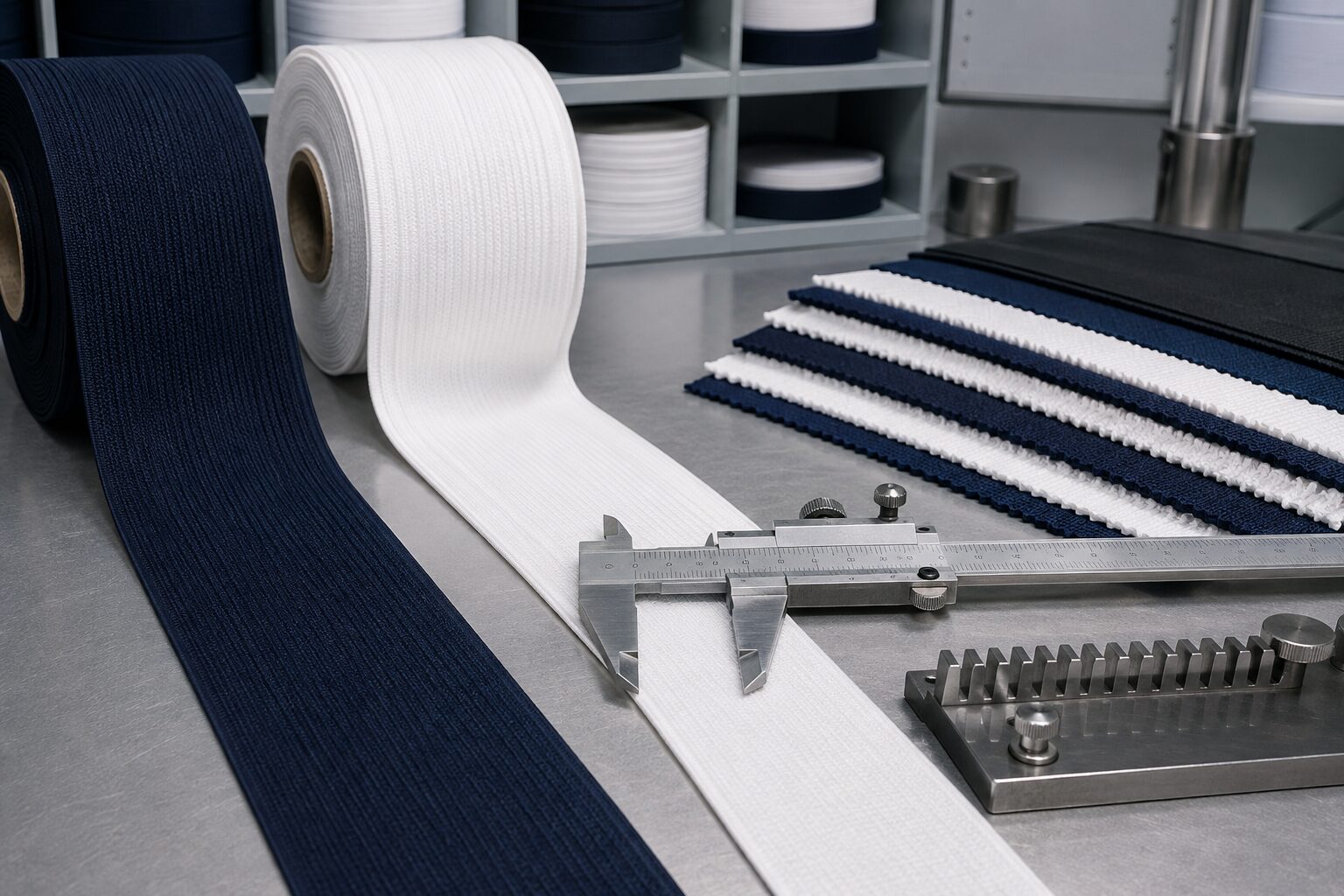
Control points are defined according to the product structure, and the process continues without interruption from pre-production to shipping.
Yarn and elastic components are evaluated according to intended use and product construction.
Dimensions, color, pattern and construction information are converted into production parameters.
Feed, tension and production setup are checked before mass production.
Width, surface, color and product construction are monitored throughout production.
The completed product is checked against order criteria and overall product integrity.
The product is prepared for shipment in a way that preserves its structure and facilitates use.
Control points vary according to the product construction and intended use.
Width, knitted surface, edge structure, elastic behavior and length consistency.
Form stability, woven surface, edge consistency and dimensional characteristics.
In addition to elastic behavior, buttonhole spacing, repeat and construction integrity are checked.
Pattern repeat, stripe positioning, color consistency and appearance under tension.
Changes in surface, hand feel, dimensions and elastic characteristics after finishing.
Senem Örme textile elastic solutions
Planned management of order and production information makes it possible to reference previous production runs and evaluate feedback more effectively.
Our goal is not only to complete a single shipment, but to build a reliable quality structure that contributes to long-term production continuity.
Share your application, fabric type, width, color and elasticity expectations; we will evaluate the most suitable product structure according to your technical requirements.