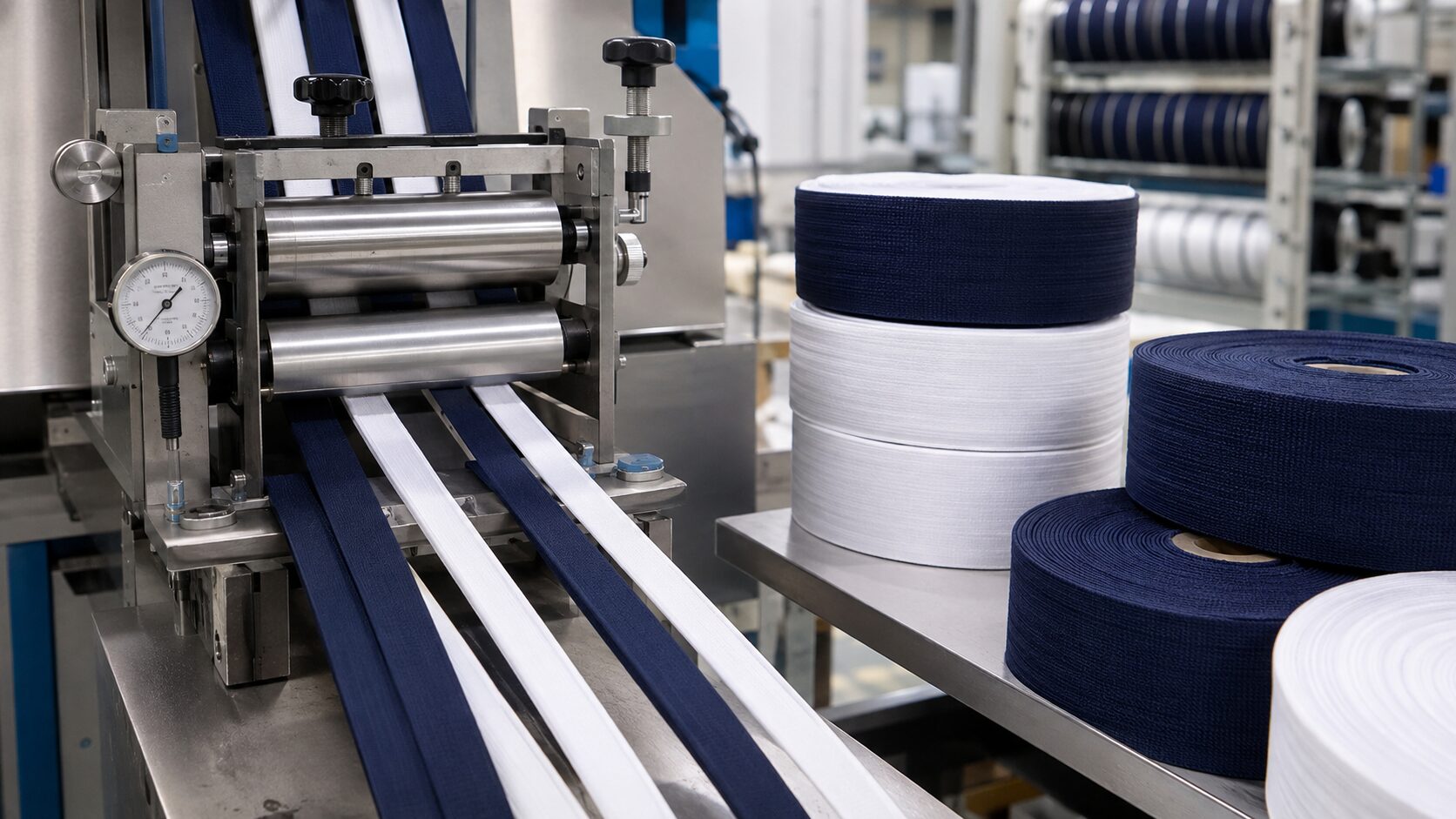
Production
A planned and controlled manufacturing approach from raw material selection to knitting, weaving, quality control, packaging and shipment.
Controlled Production Begins with Technical Planning.
At Senem Örme, production does not begin by simply starting a machine. The end use, requested dimensions, construction, elasticity, color expectations and order structure are evaluated before manufacturing starts, and production parameters are planned accordingly.
Knitted and woven elastics perform different functions in different textile products. One application may prioritize high elasticity and recovery, while another may require surface regularity, dimensional stability, long-run efficiency or special color matching. For this reason, we shape the production method around the intended use instead of relying on a single standard recipe.
Alongside standard product groups, we evaluate custom color, width and application-specific requirements. Our objective is not merely to produce the requested meterage, but to deliver a narrow textile component that can work consistently in our customer’s production environment.
From Raw Material to Shipment, Step by Step.
Yarn and auxiliary materials are selected according to end use, required construction and expected performance.
Width, construction, color, order quantity and application are converted into a production plan.
Machine settings, feeding and structural parameters are prepared and checked before serial production.
The selected construction is manufactured while surface appearance and process stability are monitored.
Product appearance, dimensions, consistency and order requirements are evaluated before release.
Approved products are prepared, packed and dispatched according to the planned delivery schedule.
Why Is Material Selection Critical?
The performance of a textile elastic depends on both manufacturing technique and the materials used. Yarn and elastic components influence process stability, appearance, handle, stretch and recovery. We therefore treat material selection as the first technical decision of production.
The intended use, construction and customer expectations are considered together so that the chosen materials can support a more stable manufacturing process and consistent final product.
Machine Settings and Process Stability
Correct machine preparation is one of the key factors that determines product character. Width, yarn layout, feeding balance and production parameters are planned according to the requested structure.
The process is observed during production and parameters are reviewed when required to support surface regularity, dimensional continuity and production efficiency.
Knitting and Weaving Techniques
Knitting and weaving create different structural characteristics in narrow textile products. Knitted structures can provide flexible, conformable behavior, while woven structures can offer stronger dimensional stability and a different surface character. The appropriate technique is selected according to the intended function.
Quality Control Starts Inside the Process, Not Only at the End.
Planning, machine preparation, process monitoring and final inspection are parts of the same quality chain. Identifying variation early helps reduce waste, rework and inconsistency.
Order details, construction and production requirements are checked before the process begins.
Appearance and process behavior are observed so potential deviations can be noticed earlier.
Finished products are reviewed against order criteria and production consistency.
Approved products move into organized packaging and planned dispatch.
Solutions Beyond Standard Products.
Textile producers do not always need a standard item. Collection structure, end use, color plan, width or order model may require a different product approach. We therefore evaluate custom requests as a natural part of production planning.
For color, width and application-specific requirements, we first define the technical framework and then assess how machine settings, construction and process parameters can be adapted.
Flexible Production Planning
Flexibility does not mean unplanned production. Different requests can only be managed consistently through accurate planning of order structure, production sequence and delivery targets.
Long Runs and Production Continuity
Long-run consistency matters for customers’ own production efficiency. Planned manufacturing, stable product characteristics and suitable packaging help support smoother downstream operations.
From Production to Quality Control and Shipment.
Our machinery, manufacturing team, quality-control workflow and organized storage and dispatch operations.


Let’s plan the right production structure for your product.
Contact Senem Örme for width, color, application or custom manufacturing requirements. We will evaluate your need and help define a suitable production solution.